
Imagine this: you start a band with your friends. The songs lean toward a modern strain of sludge and doom. There is no bass player. The compositions keep expanding, growing heavier, longer, more immersive. Before long, the lyrics begin to spill across individual tracks, forming a narrative larger than any single song could contain. Then comes a debut album recorded independently, yet brought to life in the Tonmeisterei, one of Germany’s finest studios, wrapped in artwork by Mariusz Lewandowski, one of doom metal’s most revered visual artists.
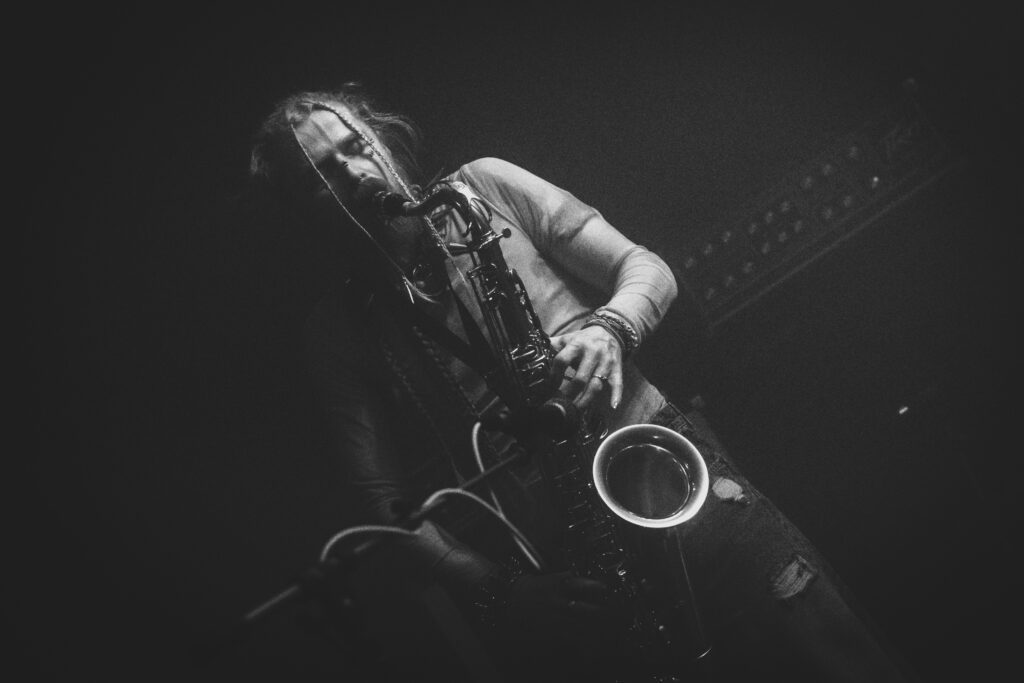
Ten years later your band has become widely acclaimed and what you have built is a world entirely of its own.Welcome to the story of EREMIT.
What follows is a conversation with Mo, the creative centre of EREMIT, conducted over two hours. It goes long because Mo doesn’t do surface. He lives inside this band, inside its mythology and once he starts talking, you begin to understand why ten years in, it still feels like the opening chapter.
Contents
I. Ten Years of EREMIT
II. Releases, Sound, and Songwriting
III. Lore and Visual Concepts
IV. Kollektiv Raumordnung
Ten years of EREMIT, that’s a massive number. What does that feel like?
It doesn’t feel like ten years, I think. But that’s always the thing with age. When I see a band that’s been around for ten years, I think: okay, they’ve really achieved something, that’s crazy. But when you think about your own journey, it doesn’t necessarily feel like “ten years.” It’s always a matter of perspective.
Of course, a lot has happened. And for us, it was also a kind of exponential growth. In the first two years, we maybe played ten shows in total, and at some point it just became more. It was a development from: we’re just people getting together, rehearsing a bit, writing a few songs, to: okay, now we actually have a record deal, we’re putting out records, going on tour, playing shows, and getting out of our village for once. And from there, a lot more really happened.
Today I posted an Instagram story on the EREMIT account about “Los Chappineros,” which is a new band by our guitarist Kalle. It’s cumbia music. That made me realize again that this year, EREMIT’s 10th year, was at the same time also, in a way, the year of side projects. Kalle plays in Chappineros. I sing in a new powerviolence band, Moral Rot. This year, Moral Rot released our first tape. On top of that, the whole Raumordnung collective thing started. That’s exciting. At the same time, this year we played more live shows with EREMIT than ever before in a single year.
So yes, it’s been a long journey, and for me it’s the first time it’s happened on this scale, even though I’ve been making music for 25 years. EREMIT is the first band that exists on this level, with this amount of work and everything that comes with it.
What was the anniversary weekend like then, where you played two shows and where all of this probably came together again. Do you get emotional in a situation like that?
Yeah, definitely. I’m generally a very emotional person, I feel a lot in all kinds of directions, and that was definitely emotional.
For me, that weekend was, let’s say, “unfortunately” also a lot of work. We, or maybe I, took on a lot. We co-organised for two days, had a huge merch stand. On top of that, we had three or four releases that weekend and played the first Raumordnung show. It was just a lot, a lot of work, and that probably overshadowed the emotional side a bit. I was basically running from A to B the whole weekend. There was one moment on day two after the Raumordnung show when I was sitting on the floor in the merch room, frantically reconfiguring my pedalboard from Raumordnung back to EREMIT with cable ties and wire cutters. Those are the moments when the others can have conversations, and I was basically just under tension the whole time.
Still, it was an incredibly beautiful weekend. Two sold-out days, lots of friends and family. People really came from Finland and from southern Germany. What people are willing to invest in terms of time and money in order to celebrate these 10 years with us, that’s just totally insane. It was emotional to see that. The event itself was a bit like an EREMIT convention, because we had a pretty big space, with a very expansive merch stand, and of course there was special merchandise. For example, I had this longsleeve design where one arm had a photo collage printed on it with pictures of people who have helped over the last ten years and have always been there, and so on. Nobody knew about that, neither my bandmates nor the other people. Those are the nice little moments: I show one of those longsleeves to my best friend, who took band photos for us for many years, and she sees that she’s on it too and gets really emotional. Or our drummer’s partner, Kara, she’s also visible on it, very tiny. She came up to me and said: “Being printed on a longsleeve was not on my 2025 to-do list.” Those are sweet little moments that of course make me happy too. And then of course there was playing the first live show with Raumordnung, which was definitely a huge moment and, I think, really did the project, the band, a lot of good.
Which milestones or key moments from ten years of EREMIT come to mind first, and which story would you absolutely want to tell about them?
I already told this story at the live show:
My best friend was also my partner in EREMIT’s early years. At the very first EREMIT concert, we made out for the first time. At that first gig, we basically got to know each other more closely. And one anecdote I always tell to illustrate how much this band completely took over my life, in a positive way but sometimes also in a negative way, is that this former partner eventually introduced a rule that after 6 p.m. we were not allowed to talk about EREMIT anymore. Why would a partner want that? Because I talked about nothing else! EREMIT, this band, this concept grew so fast that there was nothing else in my head anymore. And that’s definitely one of those things you can tell. And you also realise: if it takes over my entire life, that can also be exhausting for other people.
A lot happens in ten years, and this band has taken very different forms. Our guitarist Kalle went on world trips two or three times, trips that had no scheduled end. He literally quit his house and job and just left, with his wife. We knew he would most likely come back, but we didn’t know when. Because of that, the band at the time consisted only of Marco, the original drummer, and me. That was EREMIT for a long phase. We wrote more than a full album on our own. Then Kalle came back, we went into the studio with him, and then he basically left again. That was a few years ago, but nowadays it’s no longer conceivable, because with Hausi we now have a new drummer and Kalle is living in Osnabrück again permanently. But when I think back to 2019, that’s what I think of: first album, a lot of shows, many requests, and we were just two people. No driver, no merch person, nobody helping us carry things. Just the two of us in a car, with cabinets and guitars in the back, driving through Germany, Switzerland, Holland, wherever. That was crazy. By contrast, 2025 is now coming to an end and we’ve played more shows than ever before, and we’ve really grown together with our new drummer. That’s really beautiful, and once again it’s a new form of this band.
The statement “10 years of EREMIT” would have driven me insane three years ago, in the sense of: we still have so much to accomplish! Because we completed the first cycle, both musically and in narrative form, a certain calm has settled in for me. If I jump out the window now or get flattened by a bus, then at least I completed the first cycle. I left that behind for the world. As an artist, that was very important to me. That doesn’t mean it won’t continue, I’ve got a thousand things in my head that I still want to do, but that’s a major milestone. In ten years, we managed to complete this cycle that was foreseeable from the very beginning. I still remember the very first time we were in the studio with EREMIT, with Role at Tonmeisterei, and we talked to him about our plans. About the first album, the concept story, and the cycle. He asked: “So how long is this going to continue?” Our answer at the time was already that we had ten albums planned. Understandably, his eyes got pretty wide. We joked that he wouldn’t be allowed to retire yet because we’d still need him for a few more years. Even back then, it was clear: EREMIT means ten albums. Now, in ten years, we’ve managed three (laughs). I can’t say whether we’ll ever manage all ten. But I’m glad we completed the first cycle. In that respect, EREMIT is also like an exciting video game to me, with a predetermined ending. Ten albums, and then the story is basically told.
Whether we can really pull that off, I don’t know. Most of the work over the last ten years was on me. That means for ten years, this band was the main focus of my life. And you also have to be honest about that, it has its highs and lows. There’s an interview with the American rapper Ghostemane where he’s asked what it feels like now, with fame, glory, and money, and his answer is that of course it’s cool, but people don’t see what you gave up for it. Like friendships or family suffering because of it, or what job opportunities you turned down. I can relate to that to a certain degree. At some point there were times when EREMIT felt like a demon to me that had completely taken me over. I couldn’t think about anything else, because I had also completely tied my whole being to this band. In the sense of: I stand or fall with it. If something didn’t work out — and hey, over ten years of course a lot of things don’t work out — then it wasn’t “yeah, too bad,” it was: “My life depends on this! If this doesn’t work out, then it’s really fucked.” That’s the manic side of being an artist. I experienced that firsthand. At some point I understood that by nature I am an artist, and I love that. I studied something completely different, but this has dominated my life for ten years now, and for the time being there’s no end in sight.
I think that’s a very important point. People who get involved in the underground or DIY scene are constantly faced with the decision of what they “sacrifice” for the cause. And in your case, it also has to be said that you are a very active band. Let’s talk about the records you’ve released. There are three regular full-length albums, two EPs which are actually long enough that a powerviolence band could probably make two or three albums out of them. On top of that you released your compilation, a live vinyl, a VHS cassette, and most recently also a tape. Those are, as I said, only the physical releases, and with these publications you really only started in 2019. Given everything you described, that’s a consistently high output.
Actually, I think. there is one musical thing missing from that list. Funnily enough, I was ranting about it recently because it’s not listed on Metal Archives: this year we also put out the “Vigor of Duh~hul” tape in an edition of 50 copies. It contains one song from the fourth album, which of course we’ve already recorded as well. That’s our classic move: we basically always already have the next album in our hands. When one album comes out, we’ve already recorded the next one.
Exactly, we’ve released three studio albums. We founded the band at the end of 2015, and the first album only came out in 2019, even though Metal Archives says 2018, which isn’t correct either (laughs). The first EP was relatively spontaneous. We were in the studio, recorded five songs, and still didn’t know how we wanted to use them. At some point I came to rehearsal and suggested taking three of the songs as a full-length, because that would make a great album package, and we’d just use the other two songs as an EP. What’s interesting from a story perspective is that because of that, the two songs on the EP do not build chronologically on the previous album. Our second EP (“Rise of the Ruan~angh”) is then also a complete spin-off, the way “Rogue One” is in the Star Wars universe. With that, we created an option for ourselves that also allows us to tell stories outside the main lore. Of course that opens up room for storytelling, because it allows us to release things that no longer focus on the main character. To stay with the video game analogy: those are side quests for us. If we were to say we wanted to finish the game quickly and be done, that would be counterproductive. “Rise of the Ruan~angh” is actually my favourite release, I think. We like playing with the lore. And for me it was exciting to zoom out and look at what is happening somewhere else in this world at the same time. What could we tell, perhaps as a cross-reference to events that have already been reported?
So that means “Rise of the Ruan~angh” sits outside the story framework of the pamphlet written so far?
Exactly, yes. Speaking of which: when you look at the discography, it might give the impression that in the anniversary year there wasn’t really “the big thing.” Sure, we did the VHS and so on, but the really big release this year is actually the book. So, Pamphlet 3, the final version of the book. That’s 400 pages of high fantasy! I have to remind myself of that too, because that release was already a few months ago now, but it also came out this year. And if you want to talk about the “main release,” then this year it was the book.
That’s a wonderful sentence, and in my opinion it describes you very well: “The main release this year was the book.”
So “Rise of the Ruan~angh” is your favourite release. Looking back, both in terms of the songs and the sound, how do you view your earlier releases like the already mentioned Carrier of Weight or Desert of Ghouls?
On the first anniversary day, we played Carrier of Weight in full. So we basically had an old-school set and played those songs. The plan was also to play “Dry Land,” the first song from the first album, with Marco, the original drummer. But unfortunately he was ill, so that didn’t work out.
In terms of sound, it’s difficult. In the first five or six years I listened to EREMIT more myself, now I listen to less EREMIT. Maybe that also has something to do with how present Raumordnung is. Funnily enough, I was reading the current issue of Deaf Forever and there was a band in it that had re-recorded an album that was 15 years old. I don’t think that’s our thing. I’d rather move forward and make new things. Sure, there are things where I know I’d do them differently today, but that’s always the case. We already have a 23-minute song that is just one riff, we probably won’t do that again. Although, during the time when Marco and I were just the two of us, we actually spent a long time trying to write another “Dry Land.” We were looking for a riff like that for a long time, but it never came. Then we wrote different material instead. So that song is really a unique feature of Carrier of Weight.
With the third album, there actually are a few moments where I’d say I would do that differently today. Live, we play the material a bit differently anyway. By now there’s saxophone and harmonica and even more trumpet, we’ve become freer, more experimental. For example, the current live version of “Entombed in a Prism of Blindness,” the second song from the third album, I like better than the studio version. There’s this long section with saxophone and harmonica where we fall into a kind of Blood Incantation or 70s jam mode. That loosens up the arrangement and makes the part afterwards even darker. But I wouldn’t want to go back and change that. I’d rather integrate that into new material and keep pushing forward.
When it comes to sound, I have an ambivalent attitude. Sometimes I put on EREMIT and think: “Wow, the sound is crap. Somehow this isn’t it, why do people like this?” (laughs). But sometimes I also think: “Wow, this is huge.” When it comes to sound, I’m the one in the band who experiments the most. Kalle basically has one guitar and amp setup, and he’s been playing that since 2019. In principle, almost nothing has changed there. I, on the other hand, am always tinkering. I have two fixed mines — effect pedals, in terms of distortion — those don’t change, but I always have a second effects chain that I keep working on. Different amps, more amps, other cabinets. I try out a lot.
On the one hand, you’re searching for a riff in order to write another complete song out of it. On the other hand, your newer songs feel packed with ideas that go beyond riffing. How conscious was that step? Was it a deliberate “we have to go somewhere else,” or more a letting go of expectations that automatically led you into this sonic world?
It’s both. There are moments when we know how we want to write a song. It has XY, it’s super long or quiet or whatever. But at the same time, we write riffs and see what happens. The fact that the third album became a four-LP record was not planned at all. “Conflicting Aspects of Reality,” the first song, is 63 minutes long. That was not planned. Marco and I started writing and we just kept writing, kept writing, kept writing, and it never stopped. And at a certain point we somehow found that funny. For ages we didn’t even know how long the song was, because we were only ever rehearsing individual parts. At some point we said, let’s play it all the way through, and then we thought, okay, this is really on some Sleep Dopesmoker or Bell Witch kind of level. And funnily enough, I think the song is exactly 12 seconds longer than Dopesmoker. But that was a coincidence. A coincidence we had to laugh about.
So, like I said, it’s a bit of both. I’m someone who listens to a lot of music, likes going to exhibitions, the theatre, the cinema. I like consuming art. Often it’s like this: I hear something or see something, think it’s great, and then I want to do that too (laughs). But between that impulse and the moment when you actually start working on something, there’s always a process of transformation. How do I want to do that? How can I even make that happen? A lot of that really has to do with skill. None of us is a trained musician, formally speaking. So our skills naturally limit us too. But very concretely: I think Bohren & der Club of Gore are really great, and then at some point I came into the rehearsal room and suggested doing something quiet with saxophone. In the EREMIT guise.
The new material now is going to be different yet again. The people who already bought the tape can already get a little glimpse into the future. In terms of songwriting, it was a new feeling for us again, because now we have the second cycle and are kind of starting over a little. So: writing a first album again, but what does this first album sound like? That was exciting.
„For me, it is also like a retreat. I can always go there, I can wander around in it. And live, I see a film that does not exist. I am in this world.“
Then maybe let’s look back at the first cycle. As a band, with everything you do, you tell a story. Put very simply: a fantasy story. Could you give a brief summary of what has happened so far, as spoiler-free as you like, for someone who has had no contact with you at all up to now?
Maybe first of all: this idea that “everything is story, everything is canon,” we’re not the first to come up with it. We’re not doing this to be “more extreme.” I think it comes from the fact that I was a big metal fan in my teenage years, and I always thought album covers and artworks were amazing. Suffocation or something like that, these dark sci-fi fantasy worlds. And then you open the booklet, read the lyrics, and think: this doesn’t go together at all. He’s singing about something completely different, so what is the cover supposed to be?
Or Maiden: Eddie is everywhere, but then they sing about all sorts of things, for example Alexander the Great. I always kind of missed that it would really all connect.
I loved big worlds. Of course that also comes from the fact that when I was a little kid, my mother gave me The Hobbitand I read it. On the back flap there was something like: “There are more stories from this world.” Then the next step was getting The Lord of the Rings books, and that completely pulled me in. This idea of experiencing a completely self-contained world — that impressed me, moved me, changed me. And those two strands led to me always tinkering with a world. Even before EREMIT, I was already inventing and writing down stories in this world. Those were solo projects, but never consistent and never with complete focus. With EREMIT, I took it more seriously and really expanded it.
As for the story: we get to know a sailor, who is distantly humanoid. He lives on a ship, and he has only his father. His mother died in childbirth. He knows a simple, bipolar world: water below him, sky above him. And he knows only himself and his father. For him, there is basically only an endless horizon; there is land nowhere. But one day the father explains to him: we do not come from the water at all. We are actually strangers here. Generations ago there was a so-called world flood that took the land from us. Ever since then, we have been searching for our land. And he also more or less tells him that the two of them are probably the last of their kind. He lives in a world he does not question, and at the same time he is told: actually, you are wrong here, even though you know nothing else. It is from this emotional situation that we get to know the world and the story.
At some point the father dies. And at an advanced age, this sailor encounters another boat for the first time. Here, a being speaks to him in a language his father did not speak, but which he nevertheless understands. The being informs the sailor that he has followed a false course all his life and, with its last breath, essentially sets him on a new course. And so the protagonist, the eternal sailor, eventually finds land. That is where his journey begins. In the process, we learn that he wants to find out what caused the world flood. He wants to know where the land is from which he actually descends. And he realises that the course given to his people was more or less a curse and was meant to achieve the opposite — namely that this people should never find land. From that arise questions: who would have an interest in that? What is behind it?
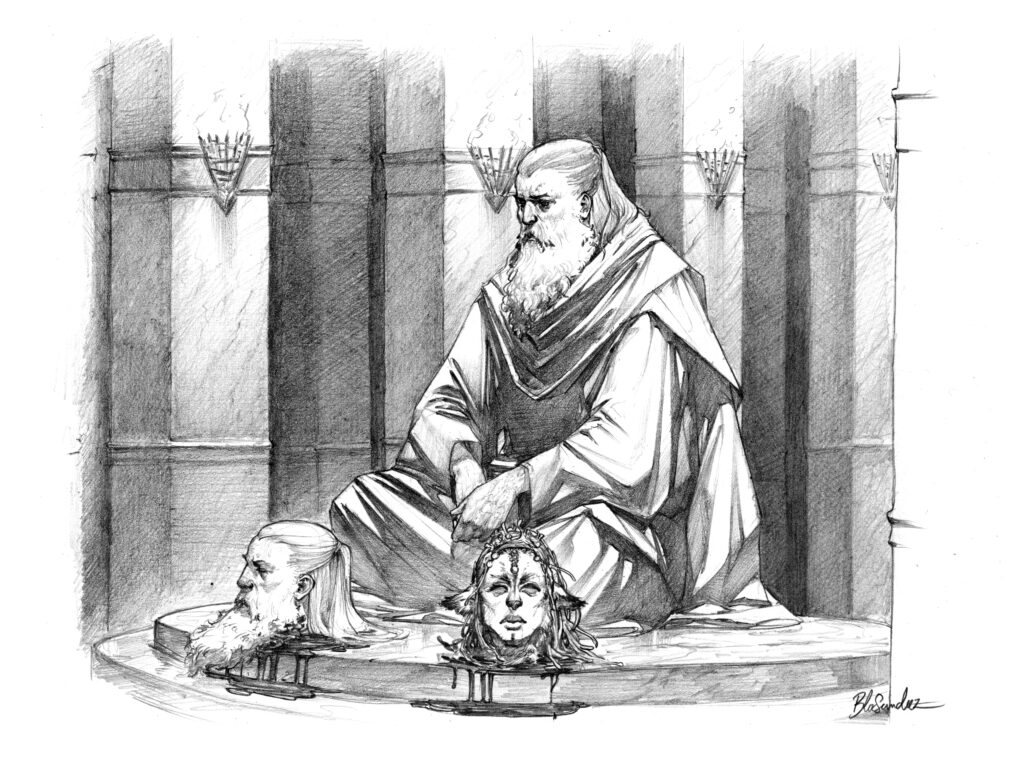
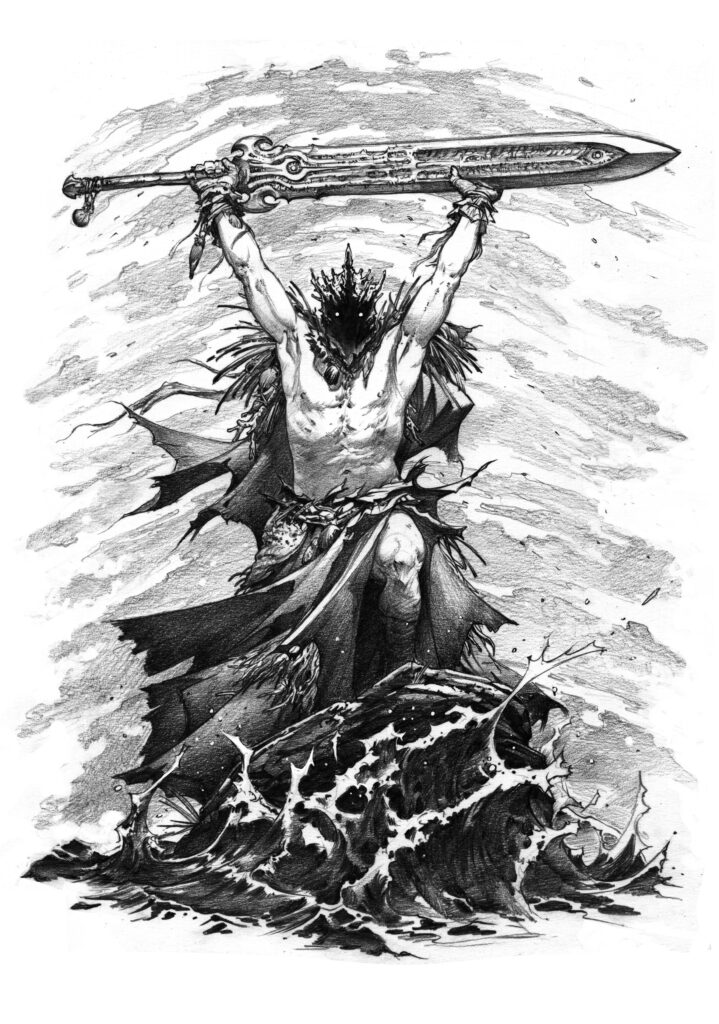
As the story unfolds, the sailor comes upon an enchanted, brutal, and harrowing land. He, who throughout his life had contact only with his father, gradually gets to know different characters. The first he meets, in the grottoes after leaving the sea, is a very old being that is in the process of dying. It is an old wizard who places knowledge and a sword in his hands. It is a special sword and, let’s put it this way, from then on many things happen.
It is a story full of introspection. We get a great deal of the protagonist’s inner world of thought. It deals a lot with despair, with questions, and with uncertainty. He is surrounded by a world he does not know. Finding answers is very difficult. The world is hostile toward him, and he often does not know why that is. And yes: we make metal music, but someone is screaming there, someone is suffering. That feeds directly out of the story. There are also beautiful moments. Later, he meets a character who accompanies him, and for the first time warmth returns, affection, an intimate bond. And then for a long time we follow this twoness. Friction also develops there. Sometimes the two are closer, sometimes more alien to one another. But they always seem to be following the same quest.
It is a long journey, 400 pages of high fantasy. I always say: it is a draft version, that is why it is called a pamphlet. We have three pamphlets: Pamphlet 2 includes issues 1 and 2. Pamphlet 3 includes 1, 2, and 3. At the moment all versions are sold out, but there will be a second edition of Pamphlet 3 next year (2026). I wrote this book for ten years. A great deal of work, a great many hours went into it. At some point my mother started reading the story and stopped because she recognised me so strongly in it. She became quite emotional while reading it. At first glance, that is something positive — the book moves people. And it gives me immense satisfaction that we created a universe like this, where everything belongs together. I also like saying this at shows: every T-shirt artwork, every cover artwork, every piece of text, every song, everything belongs to this story, everything is canon. You can show me any shirt from the last ten years and ask: what is this, where does it take place, in which song does this happen? And I can say a lot about it. For me, it is also like a retreat. I can always go there, I can wander around in it. And live, I see a film that does not exist. I am in this world. It is a tool for getting into the right mood and conveying feeling, because I can let myself fall into it and feel the characters, because I have been with them in this world for ten years.
When you say that while playing live you see a film, what does it feel like when you work with so many artists and then suddenly see the grottoes you mentioned visualised, or find yourself looking into the protagonist’s eyes on a hoodie?
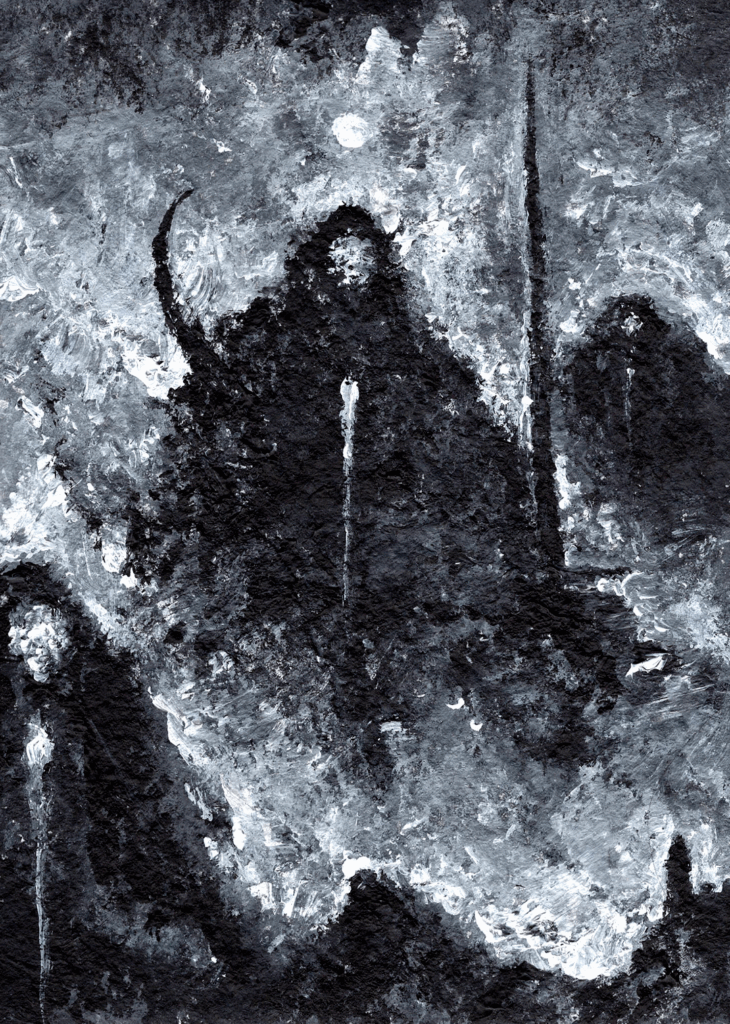

In most cases, it’s like Christmas for me. I absolutely cannot draw, I have zero talent for it. I’m completely dependent on other artists visualising this world that I have in my head. And I’m really fortunate that I get to experience that. I’m sitting at my PC, I see an email, I see an attachment, and I think: okay, wow, now I’m seeing something new. That gives me tremendous joy. I’m happy that over the course of ten years I’ve been able to commission artwork so often and work with so many wonderful artists. Of course, it’s a filtering process. It never matches my own imagination 100 percent exactly, because the artist’s style, perspective, and expression are always part of it. There has also been friction there. What do I like, what don’t I like. Sometimes the language barrier comes into play as well, and then you ask yourself how to get that across in an email, maybe in English, though the person may speak neither German nor good English. Then you keep refining it. I’m incredibly proud of our visual channels over the last ten years. Visually, we’ve created something coherent and given glimpses into this world. In my ideal vision, maybe I would have had the same artist from beginning to end. But in the real world, tastes change, and artists change too. In the early years, for example, we worked a lot with Ryan Choi, an incredibly talented illustrator who did many of the desert illustrations. And at some point he stopped illustrating and became a boxer. I could have worked with him all the way to EREMIT Part X, but that’s just how it goes. I wander through digital galleries, Instagram feeds, I see artists and think: “Wow, that’s good.” Through the band I have certain resources and can at least ask what an illustration costs. Maybe funny as well: people think I painted the oil paintings for the albums. Spoiler: I didn’t. I can’t write music, write a book, and also paint oil paintings. At some point, that’s the limit.
And it really isn’t limited just to the covers or the artwork for your records. While preparing for this, I put on the live vinyl from Kaufbeuren again and for the first time really looked closely inside the slipcase: there’s a face staring back at me. On every page, everywhere there is space, there is art. It’s not limited just to the oil paintings.
That’s a beautiful sentence. “Everywhere there is space, there is art” — that is exactly what we try to do. I like physical media very much. I’m a big lover of comics and graphic novels. I like having something in my hand. Over ten years, a lot of brainpower has gone into the conception of our physical releases. I’ve been working for many years with Sabrina Stegmann, a school friend. She is a designer and is now the in-house designer for Drei Gleichen, our label. Being able to create art together with good friends is something else entirely. It’s a gift.
We’re talking about art, the oil paintings, and the fact that everything is canon. Everything is one world. Let’s step into this world that you describe, illustrate, and portray musically. We follow a protagonist, on a world. This world consists of three bodies. On your last album, EREMIT 3, this is beautifully illustrated. Visually, you have to imagine it as a hollowed-out cylinder into which a sphere “breaks.” If I understand it correctly, that creates three bodies: a sea, something solid, and a gaseous world of mist. Could you describe this structure a bit more closely?
For me, it was always important not to simply use our Earth as the setting. I loved Tolkien’s world, but I also somehow found it a shame that it is basically our world. I tend more toward sci-fi there. That means completely different living conditions, different from our world, different from our universe. In discovering this world, I asked myself fundamental questions. For example, where the light comes from. If there are no stars emitting light, as there are for us, then how does anything exist at all? And that’s how I arrived at this form. “Ya~wa,” this world, consists of a world-sea, spherical, set inside a hollow cylinder. This cylinder is solid matter, a world of cliffs, a terrestrial body. And it is filled with a world of mist, of which we know the least so far. This structure in turn exists inside a larger body. Of these bodies, the “Sabeih~kura” or “Eon,” many exist. These are very, very large, jellyfish-like lifeforms that move through a space I do not want to explain in more detail here.
That means: the EREMIT story takes place in one world, but this world is only one of several inside an even larger organic living being. Box in box in box. Actually a bit like in Men in Black. At the end of Men in Black 1, the camera zooms out and you see how small everything is, that our whole universe is only a marble and some aliens are playing marbles with it. This scaling of size and this ambivalence between “it is completely irrelevant because it is so small” versus “for the beings inside it, it is the whole world.” It is like with us: we have known for over 100 years how big the universe is, and yet we still live our individual lives. I find that ambivalence totally fascinating. It is reflected in the world of EREMIT as well. There are large entities there, small entities. With the Raumordnung collective, the story begins exactly at the moment when EREMIT will end, after the ten albums.
It is structured a bit like The Hobbit and The Lord of the Rings. Again, transitions and larger scales. And the large is found in the small, the small in the large, that has always interested me. That already existed in the world before EREMIT. The previous band, Dragged, had already told stories from this world. But EREMIT made it more concrete, and through the collaboration with visual artists I was able to illustrate it more strongly. That is why there are also these images in the third album and in the third pamphlet. They are glimpses, so that one can better understand where one actually is, and that it is less of a universe as we know it.
A really great take. For me, that was an aha moment, seeing it visualised like that. Especially in retrospect, when you have heard Raumordnung and then see the Eon again.
If we zoom in there: in an interview you once spoke about the language in this story and how it came into being. What I asked myself is this: does the world actually also have a written form of expression? In many of your designs, what I’d call tribal-like ornaments appear. Are those readable characters or, in the broadest sense, forms of communication?
That is somewhere on my to-do list, that I make some kind of iconographic representation or explanation of symbols, because over these ten years we have created a depth of symbols that is not to be underestimated. In the second pamphlet there is the seal of Un~nu~in-wamu on it, and we used that a lot in the first five years. Then there is the Drei Gleichen symbol, the three floating figures, our label sign. Then these tribal-like, insect-like symbols, which appeared for the first time with the third album and the live vinyl. Of course, they have a meaning, they come from certain corners of the world, belong to certain characters. I really should go into that more concretely at some point. So which symbols stand for whom, who uses them.
The idea for these ornaments has to do, on the one hand, with the fact that I find symbolism itself exciting. Besides that, it is a classic sci-fi element. Protagonists enter a temple, discover symbols, at first do not know what they mean, and only as the story unfolds does it become clear. I like playing with that. And I also discover the world myself while talking about it. If we are talking about it now, I immediately feel like wandering into that part of the world and thinking about who lives there. What materials do these inhabitants use? How do they document things, and how does that shape the symbolism? Outwardly, it is a game of knowledge and ignorance, but not because we want to keep anything secret. It is more a question of complexity and how much space or time we have. If someone says we tell too little of our lore, then I say: there is a 400-page book. There is no shortcut, you have to read it. There I have to quote the Bielefeld sociologist Niklas Luhmann with the sentence: “Complicated objects must also be presented in a complicated way, otherwise one does not do them justice.” On the other hand, of course one also has to say: I am not Tolkien. I am not a linguist. I have not built a completely coherent artificial language. There are proper names, words, but not a whole language. The book also grew organically. I started it without a plan, and I think you can also notice while reading that you are accompanying an author who worked on it for ten years. I think the beginning of the book certainly reads differently from the end.
I’d like to come back once more to this comparison with a video game.
There is a main quest, and that is the music. But you can also read the book in order to dive in even deeper. In addition, there is, for example, the comic for Raumordnung. If you pay attention, it becomes relatively clear again on the first pages that there is more to understand about the world of EREMIT.
And there is lore content that you can only find on certain T-shirts. Or things are written in the albums that are not in the book. Lyrics in songs are again different from the corresponding chapter in the book. It is a puzzle game, and I like that. Cross references like in Jodorowsky. Inside the live vinyl, it said “The Future Will Show” on one side and “The Rise of the Ruan~angh” on the other, before Rise of the Ruan~angh came out. That probably makes the nerd heart beat faster. It is similar now with the prologue comic you mentioned: it is meant to give a taste, to create question marks. And yet, as an EREMIT listener, you recognise: “Wait, I’ve seen that before.”
Because you mentioned the lyrics: I think you would be withholding something from yourself if you did not read your lyrics for what they are, because they are more than just one part of the music. Your lyrics fluctuate strongly: sometimes very narrative, almost like prose, sometimes extremely abstract. I have two examples of this contrast. The battle description in “Beheading the Innumerous” on Desert of Ghouls, and then “Passages of Poor Light” from Wearer of Numerous Forms differ very strongly. With the latter I always think: this is the scored season finale. You do not decide by chance which form a text takes for which chapter, do you?
I always already know roughly what happens in a song. There was actually never a case where we had written a song and I still did not know what happens in it. Maybe right at the beginning, on the very first album. Back then we wrote riffs months before I wrote lyrics. But in the bigger picture: I already know what it is about. I mostly write the lyrics to already existing songs. And I also orient myself toward the song. Black metal parts, quiet sections, ambient parts, they have a meaning, they are not random, they are linked to the lore. The lyrics should correspond to that. For a few years now, it has usually worked like this: I have a demo recording from the rehearsal room and first I just write down what happens, without it having to be beautiful. Simply: what happens in this chapter. From that, phrases crystallise in the next step. Then I look at how these phrases fit the riff. I like collecting words. I like sound and meaning. I hear a word somewhere and think: “That’s intense.” “Aqueduct,” for example, is a word I like, it has been lying around for years, maybe at some point it will fit and I will use it.
Even back at university, I always had two notebooks: one for the seminar, and one for words, sentences, phrases that I liked. And sometimes that flows straight into it. On the third album there is the sentence “From where I stood, I heard the sickening whacks” — that is taken almost word for word from a book about Gandhi’s Salt March, where it describes how people are beaten to death. That sentence hit me so hard, and there is a similar scene in our story, so the sentence flowed into it. That is how lyrics sometimes emerge from the narrative perspective, sometimes as pure image words without sentence structure, only through atmosphere. With Raumordnung it is different again: there is a narrator in German, Japanese parts, English parts. It is unfolded in a completely different way.
Before we get to Raumordnung, I’d still like to talk with you about the next EREMIT release. You already said earlier that in 2026 people can expect a new EREMIT full-length, and that a few things will change a bit. What can you already say?
Yeah… actually I can say too little about it, or I want to say very little about it.
Just this much: the album is recorded. For the first time during studio recordings, I cried, and I cried from laughing. It was perhaps the most emotional recording process of an EREMIT album so far. We had a lot of joy, we really doubled over laughing at the thought of how people would hear it. And on the other hand, there were moments when I was so shaken that I cried, when things perhaps did not work the way I wanted them to. Because of the story, it is a restart. We did not record it this year, but already in 2024. That means we’ve had it in our hands for quite a long time already. It has been pushed back a bit because of Kollektiv Raumordnung. Also, at the moment (December 2025) there are still open questions regarding the artwork. I’m not 100% happy with it yet. But: it is supposed to come out next year. In my head, I’m already further ahead again. We have not recorded anything more yet, and we also have not gotten very far with writing, because we played a lot live with the new drummer. But there is already a plan for what comes after, we have written a bit. But first EREMIT 4 has to come out.
EREMIT 3 was, of course, completely insane: an opus of over two hours. You can’t top that. And writing an album after that was not so easy. EREMIT 4 comes from the same studio session as “Rise of the Ruan~angh,” it was recorded in one go. In terms of sound and content, I don’t want to reveal too much. But in terms of content, it is a new cycle, and we get to know a female hermit who sets out and also has a journey ahead of her. It is a little schizophrenic: the story naturally takes place in the EREMIT universe, three stories that are interwoven, running in parallel, somehow the same and yet different. That is also where the name of our label, Drei Gleichen, comes from. So in a way it is a parallel world we enter with EREMIT 4. You will recognise a lot, but at the same time it is somehow different. In the best case, it will make a few brows furrow and a few heads nod (laughs).
I actually wasn’t going to ask this anymore, but now you more or less brought it up yourself: the number three is mythologically enormous in our world. Simply through things like birth, life, decay. Is that a principle for you?
I can’t say exactly why. Probably because of our socialisation, in this world. Three is just very present. It was never a process like “should it be four or three?” — it is simply three. That is also stated in the introduction to the book: the story as we read it is coloured by the lens of my mind. How it “really” is, we never know. And this mind knows only this world in which we are, and there three is prominent. I think that simply carried over into the EREMIT story.
Let’s move from EREMIT to the “twin entity.” The new Kollektiv Raumordnung, even though you say you have actually been working on it under the surface for four years. Musically speaking, it is something completely different. How did that idea come about?
Kollektiv Raumordnung is the “next big thing” for me, so to speak. A lot of work has gone into it. At least four years. The idea for Raumordnung was originally supposed to become an EREMIT EP. I wanted to zoom further out in the lore and tell a story in another part of the world. And acoustically, I wanted to move away from what EREMIT does. An EP that would become completely different. Then the idea matured, became larger, and at some point it was clear: this is not an EREMIT EP. Raumordnung is supposed to become its own band. And I was hyped immediately. Two bands telling stories in their own language, in parallel, within the same universe!
For the realisation of it, it quickly became clear that I wanted to approach it differently. Not as a classic band, but as a collective. I know so many artists, videographers, costume designers, musicians, illustrators, all scattered across the world. Over ten years I’ve had the chance to get to know so many exciting people. And I thought: this has to be brought together. Doing things you would not dare do elsewhere. That is how the collective idea emerged. Wild and free. At the moment we are more than 20 people, if you count everyone. We structure the framework of Raumordnung in generations. On December 5, the first album, “Stewards of Eon,” was released. With that and with the prologue comic, we are at the beginning of Generation 1.
For me, releasing a comic also made total sense. EREMIT tells its story in novel form, in literary form, and Raumordnung tells its story in graphic novel form. I’m a comic nerd, I love visual art, and I have also engaged academically with graphic novels. So it was exciting not only to write music, but also, together with the Polish artist Dariusz Kieliszek, to realise a comic strip and a storyboard. We had already worked with Dariusz on EREMIT as well.
So now we have a new band that exists in the same universe. But I think you can hear that it belongs there. That boundlessness was something that really appealed to me. In Gen 1 I was still very much taking the lead, but I hope that in the coming generations it will become much more collective. Right now it is my passion project. We have the music, the comic, we took photos, we shot videos. I was in France on a bouldering holiday and had my huge backpack with me: tripod, camera, costume. With that I disappeared into the wilderness south of Paris and recorded material. Work was happening in all sorts of places. I’m super happy that “Stewards of Eon” is released.
We’ve also already received feedback, quite positive. Some people speak of a musical plot twist, and that makes me happy. Seeing boundaries, crossing boundaries, realising things you had not imagined — that inspires me. And there are still a few releases coming in Gen 1. In 2026 we want to continue growing with the collective and writing music. I’m very euphoric, at the moment it is a passion project.
You say that for the first release you were taking the lead. I found it exciting that there is a psytrance passage in it. And I asked myself: what happens when Mo is not the one in “artistic control,” but, for example, your soprano singer, if she takes the lead one day and thinks openly? Is that the direction?
Yes, I think that is the direction I’m thinking in. In Gen 1, it was like this: I wrote an acoustic script in order to make clear how I imagined the album. So I literally wrote down: first this happens and then this happens. Then we put it together, but gaps emerged as well. I went into the studio with Role with a plan like that on paper and showed it to him: “This is my plan. You may ask me sometimes what comes next, and I will not always know.” It was freer than with EREMIT. With EREMIT, we go into the studio with finished songs and change very little. Raumordnung: plan on paper, but what it would look like in the end was open for us. We experimented in the studio, things turned out differently.
At the moment we are planning within the collective, and the idea comes from Derk Trei, the narrator on “Stewards of Eon,” to do a workshop weekend next year. Because we realised there is a threshold for participation, because the lore is so large. People would like to contribute something, also to write music, but they think they do not know the lore well enough. They are afraid of doing something wrong, because Moritz is the mastermind. I want to shape that differently. We are going to sit down together, and I will explain the lore in detail with PowerPoint. And we are not just writing music, I am also opening up the artistic direction. Whoever wants to write a short story can do that. I want to open up the universe so that people can produce material that is canon. Still with my supervision, but definitely more freely. Exactly the question of what a Raumordnung release would look like if Linda Hennen, the opera singer, took the lead — those are questions I like pursuing. After ten years of ERMIT as a classic three-person band in which one person has the final say, that is already a new level. An artistic community creating something together.
Although: everyone from ERMIT is also involved in Raumordnung. Kalle, Brede, Marco, the original EREMIT drummer, plays drums on the album. It is closely interwoven, it remains family. And then there are 16 others who partly did not know each other at all. At the photo shoot, some of them met in person for the first time, and in that way it is also an exciting gathering of artists from all over Germany and beyond. That is simply a great challenge for me, to give up even more control there and perhaps stand there without having to be the director, but maybe just someone who brings a few ideas. You may notice, I really find that incredibly exciting.
That really does sound very, very exciting. I do not want to repeat my review here, but what you are describing fits exactly, for me, with what you delivered there. For me, it is an extreme form of a musical radio play, and I’m looking forward to what is still to come. I think with that we are slowly reaching the end, Mo. Is there anything you would like to say in closing?
In general, I simply find it beautiful that people are interested in the art we make. With EREMIT we are an extremely niche band. Kollektiv Raumordnung is certainly at least just as niche. It is still surprising, positive, and wonderful that the music and the art we make moves and interests people. And somehow I am very glad that over the years we have been able to build a beautiful universe and also such a lovely circle of friends, acquaintances, and fans with whom we can experience all of this together. It is a really beautiful space that has emerged. And of course, let’s say, it has also intensified the friendship between Kalle, Brede, Marco, Hausi, and me immensely, because you simply do so much together and experience so much together. That enriches all of our lives tremendously. And I’m curious about what is still to come, meaning what we have already recorded and what will be released at some point, and of course what is not foreseeable at all yet. And I hope the world keeps turning in such a way that we can continue making art, even if nowadays everyone can probably produce something like EREMIT with one click using AI. We still do it by hand. I can’t do otherwise, I have to make art. That is the constant in my life. And I’m very curious to see what is still to come.
For me personally, another completely different door also opened some time ago. I got an acting role in a film set in the metal world. It had its world premiere in Zurich at the film festival a few weeks ago. And soon I will be at film festivals again. That is another completely different universe that has opened up for me as an artist and as a person in a scene. That is incredibly exciting. And I’m very curious to see how this film, once it comes to German cinemas, will be received by the scene, what it will be like that “the guy from EREMIT” is acting in it.
Unfortunately I can only tease it, because the film is not out yet. But for people who are into visual things and are interested in metal and so on: I think at some point an interesting, exciting film is coming, in which several musicians from the scene are involved. Amenra are also part of it, for example. A really exciting film is coming.
I can definitely tell you this: I had already heard about it. Apparently word is getting around. I’m curious, and congratulations on being asked to do something like that.
Thank you! That film shoot, the whole experience, was one of the most beautiful experiences of my life. I was not doing well at all at the time, and then getting out of that, living in Switzerland for a while and being an actor in a cinema production, that was surreal. It enriched me tremendously. Another aspect, now that the film has been shot, is the premieres I get to attend. That really is crazy. I am very grateful that I was allowed to take part, and that I still get to be part of it now.
Mo, thank you so much for taking the time for this conversation.
All the best for all your projects!
Thank you as well for your interest and your time!
Listen & Follow
EREMIT
Kollektiv Raumordnung